
Introduction
Waters CryptoProNetwork com appears to refer to a cryptocurrency market information section associated with the CryptoProNetwork name. Search results for the phrase describe topics such as market structure, liquidity, order books, spreads, and exchange mechanics. However, similarly named domains exist, so identifying the correct website is an essential first step. This guide explains the terminology behind the search, how to evaluate cryptocurrency market information, and what readers should check before trusting a website or making a financial decision.
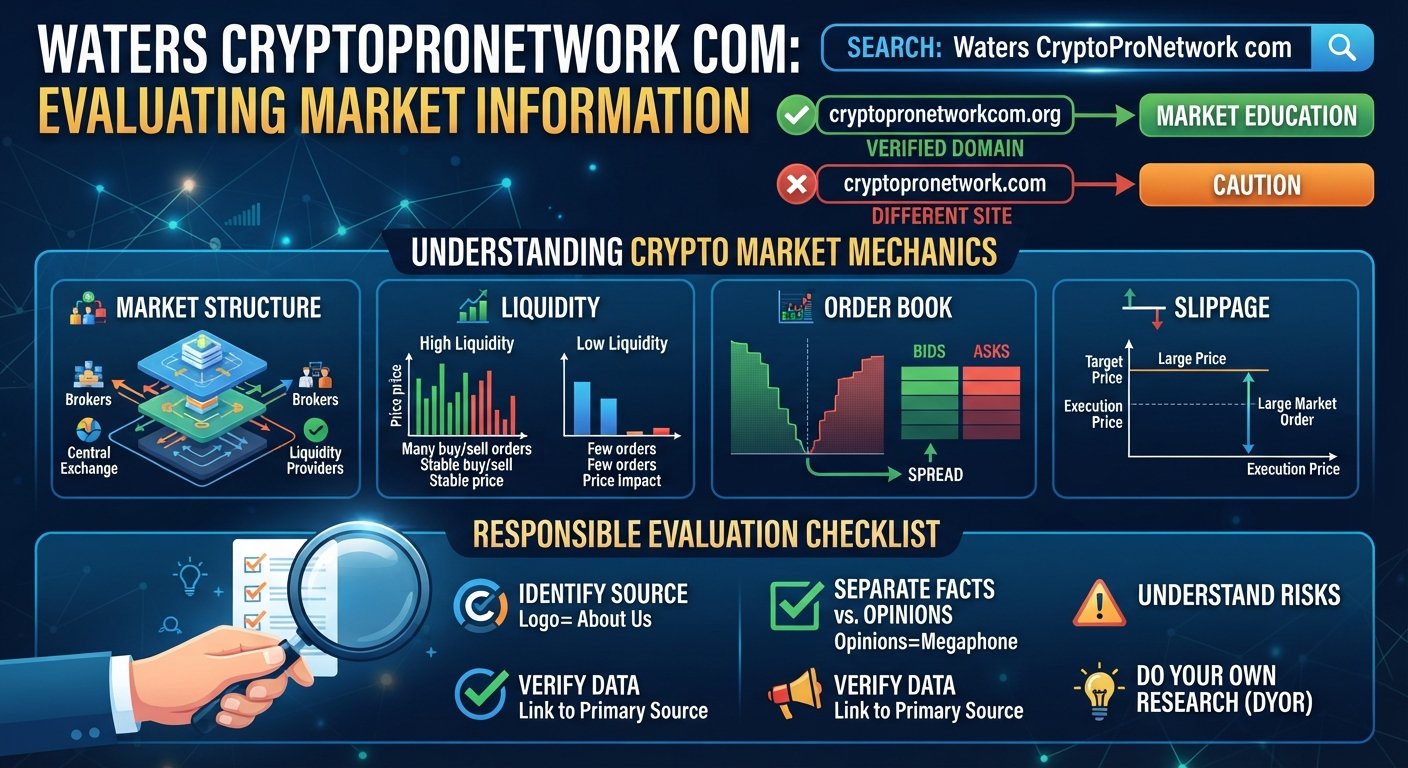
Quick Answer: The phrase “Waters CryptoProNetwork com” appears in connection with educational content about cryptocurrency market mechanics. One search result describes “Waters” as a markets section covering liquidity, order books, spreads, and slippage on cryptopronetworkcom.org. Verify the exact domain before assuming it is connected to another CryptoProNetwork website or service.
What Is Waters CryptoProNetwork com?
The search phrase combines three elements: “Waters,” “CryptoProNetwork,” and “com.” It may be a search for a named section of a website rather than a standalone cryptocurrency exchange or investment platform.
A search result for cryptopronetworkcom.org describes a section called “Waters” as a market-education resource focused on how cryptocurrency markets operate. Its listed topics include liquidity, order books, spreads, slippage, market makers, and exchange mechanics.
That description provides a useful starting point, but it is important to distinguish a website’s own statements from independently verified facts. The existence of an educational page does not prove that its operator is licensed to provide financial services, and it does not establish that the site is affiliated with another domain using a similar name.
Why the Exact Domain Matters
Online, small differences in a domain name can lead to entirely different websites.
For example, cryptopronetwork.com and cryptopronetworkcom.org are separate domain names. A visitor should not assume that they share ownership, security practices, authors, or business operations simply because their names look similar.
Before reading an article or following a recommendation:
- Check the complete domain in your browser’s address bar.
- Confirm that the link matches the source you intended to visit.
- Review the website’s About, Contact, and editorial-policy pages.
- Look for a clear explanation of who publishes the content.
- Treat claims about partnerships or official status as unverified until corroborated.
This basic check can prevent confusion when several websites use similar branding.
What Topics Does the Waters Markets Section Cover?
Based on the available description associated with cryptopronetworkcom.org, the section focuses on the mechanics behind cryptocurrency markets. Understanding these concepts can help readers interpret market data without confusing educational information with trading recommendations.
1. Market Structure
Market structure describes how buyers and sellers interact, how orders reach a marketplace, and how prices are formed.
Cryptocurrency markets can involve centralized exchanges, decentralized exchanges, brokers, liquidity providers, and other participants. Each system may use different rules for matching orders, calculating fees, and processing transactions.
Understanding the structure of a market helps explain why the same asset can display slightly different prices across trading platforms.
2. Liquidity
Liquidity describes how easily an asset can be bought or sold without causing a substantial change in its price.
A liquid market generally has sufficient buying and selling interest near the current price. In a less liquid market, even a relatively small trade can move the price more noticeably.
Consider a hypothetical example:
- Asset A has many buy and sell orders close to its current price.
- Asset B has very few orders available near its current price.
- A buyer submits an order worth $5,000 for either asset.
The order may be filled with little price movement for Asset A but cause greater price movement for Asset B. The actual outcome depends on the available order book and how the order is executed.
Liquidity is particularly important when dealing with small cryptocurrencies, unfamiliar trading pairs, or markets experiencing sharp price movements.
3. Order Books
An order book lists outstanding buy and sell orders for a particular trading pair on an exchange that uses an order-book model.
Buy orders, often called bids, indicate prices at which participants want to purchase an asset. Sell orders, known as asks or offers, indicate prices at which participants are willing to sell.
A simplified example might look like this:
| Order type | Price | Available quantity |
|---|---|---|
| Highest bid | $99.90 | 20 units |
| Next bid | $99.80 | 35 units |
| Lowest ask | $100.10 | 15 units |
| Next ask | $100.20 | 40 units |
These figures are illustrative, not live market data.
The highest bid and lowest ask are separated by a difference called the bid-ask spread. An order that consumes multiple price levels may receive different execution prices for different portions of the trade.
An order book can provide useful information, but displayed orders may change or disappear before a trade is completed.
4. Bid-Ask Spreads
The bid-ask spread is the difference between the highest available bid and the lowest available ask.
Using the example above:
[
\text{Spread} = $100.10-$99.90=$0.20
]
The spread can be expressed as a percentage of a reference price to compare trading conditions across assets.
A narrower spread often indicates a lower immediate trading cost, all else being equal. However, the spread is only one component of the total cost of a trade. Exchange fees, slippage, withdrawal charges, and other expenses may also matter.
A wide spread can make frequent trading more expensive, especially when a trader repeatedly buys and sells an asset.
5. Slippage
Slippage occurs when the execution price differs from the price a trader expected when submitting an order.
It can happen because prices change, available liquidity is insufficient, or a large order consumes several levels of the order book.
For example, a trader may expect to purchase a token at $10.00, but the completed order has an average execution price of $10.08. The difference is slippage, although the precise calculation depends on the reference price and execution details.
Slippage is not always negative. Prices can also move in a favorable direction between the expected and actual execution.
To manage potential slippage, traders can review available liquidity, understand order types, and avoid assuming that the price displayed on a chart guarantees the final execution price.
6. Market Makers
Market makers are participants that provide buy and sell quotes, helping other market participants trade.
In some markets, they may earn revenue from the spread or other arrangements. Their activities can contribute to liquidity, but their presence does not guarantee stable prices or prevent losses.
Market-making activity also differs across centralized and decentralized trading systems.
Readers should be cautious about claims that a particular market maker guarantees a token’s price, protects investors from losses, or ensures that an asset can always be sold.
How to Use Crypto Market Information Responsibly
Educational material about market mechanics can be useful, but it should form only one part of a broader research process.
Step 1: Identify the Source
Start by checking the exact page and domain. Determine whether the material comes from an educational publisher, an exchange, an independent analyst, or a company promoting a particular token.
Look for the author’s identity, publication date, sources, and disclosures. If the article discusses rapidly changing market conditions, check whether the information is current.
Step 2: Separate Facts From Opinions
A market article may contain several types of statements:
- Verifiable information, such as a published exchange fee.
- Interpretation, such as an explanation of why liquidity changed.
- Forecasts, such as a prediction that a token’s price will rise.
- Promotional claims, such as an assertion that a project is a guaranteed opportunity.
These categories should not receive equal weight. A documented fact can be checked independently, while a forecast remains uncertain even when its author has relevant experience.
Step 3: Verify Market Data Independently
If an article discusses trading volume, prices, liquidity, or token supply, compare its claims with reliable primary sources where possible.
Check the exchange or blockchain data relevant to the claim and make sure the trading pair, timestamp, and measurement are consistent.
For example, a token’s reported daily trading volume on one exchange may not represent its total trading activity across all markets. Likewise, a quoted price may not be available for a trade of the size you intend to make.
Step 4: Understand the Risks
Cryptocurrency markets can be volatile, and a website’s educational content cannot remove that risk.
The U.S. Securities and Exchange Commission warns that crypto-asset investments can be speculative and may lack important investor protections. Losses can arise from market movements, platform failures, fraud, technical problems, or withdrawal restrictions.
Never interpret a general market explanation as a promise of profit.
Step 5: Make Decisions Based on Your Own Research
Before making a transaction, consider your financial circumstances, the asset’s purpose, the risks of the platform, and whether you can afford the potential loss.
Avoid making a decision simply because an article uses technical language, a confident tone, or an impressive-looking chart.
If you do not understand how a proposed transaction works, pause and seek reliable, independent information before proceeding.
Is Waters CryptoProNetwork com Legitimate?
The answer depends on what you mean by legitimate.
A website may exist and publish educational content without being a cryptocurrency exchange, a registered financial adviser, or a verified investment service.
The available search result describes the Waters section as educational and states that the website is not a financial service and does not hold customer funds. Those are statements attributed to the site description, not an independent audit of its operations.
The evidence discussed here is not sufficient to establish the site’s ownership, regulatory status, overall security, or long-term reliability.
A Practical Website Verification Checklist
Before trusting the website, check the following:
Domain identity: Make sure you are visiting the exact domain you intended to access.
Author information: Check whether contributors have identifiable backgrounds and whether their claims can be independently verified.
Editorial transparency: Look for publication dates, corrections, citations, and clear distinctions between education and promotion.
Privacy and security: Review the privacy policy and avoid sharing passwords, wallet recovery phrases, or private keys.
Financial claims: Be skeptical of guaranteed profits, fixed high returns, or pressure to deposit funds immediately.
Affiliations: Confirm important claims about partnerships or official relationships through the organizations supposedly involved.
A website’s design, search ranking, SSL certificate, or number of published articles is not enough to prove that its financial claims are trustworthy.
Common Mistakes When Researching Cryptocurrency Websites
Readers can make better decisions by avoiding a few recurring mistakes.
Confusing Similar Domains
A familiar brand name does not prove that two websites are connected. Always compare the complete domain rather than relying on the words displayed in a search result.
Treating Educational Content as Financial Advice
An explanation of liquidity or market structure does not tell you whether a particular cryptocurrency is a good investment. General education and personalized financial advice serve different purposes.
Relying on a Single Source
One article may contain outdated information, incomplete data, or an author’s interpretation. Compare important claims with primary sources and independent reporting.
Assuming Technical Language Means Expertise
Terms such as blockchain, market making, liquidity, and order-book depth can sound authoritative. Their presence does not establish the author’s qualifications or the accuracy of the conclusion.
Ignoring Security Basics
Never disclose a seed phrase or private key to a website claiming to offer analysis, account verification, or investment support. Anyone who gains access to those credentials may be able to control the associated assets.
Frequently Asked Questions
What is Waters CryptoProNetwork com?
The phrase appears to refer to a markets section associated with the CryptoProNetwork name. A search result for cryptopronetworkcom.org describes content about liquidity, order books, spreads, slippage, and exchange mechanics. Verify the domain before assuming that it is connected to similarly named websites.
What does the Waters section cover?
According to the available site description, it covers cryptocurrency market structure and trading mechanics. Topics include liquidity, market makers, order books, spreads, and slippage. These are general market concepts, not proof of a trading or investment service.
Is Waters CryptoProNetwork com a cryptocurrency exchange?
The available description presents the section as educational content rather than a service that holds customer funds. There is not enough verified evidence here to identify it as a cryptocurrency exchange. Check the official page and its terms before making assumptions.
Is Waters CryptoProNetwork com safe to use?
Safety cannot be determined from a name or search result alone. Verify the domain, review the site’s privacy and security practices, and avoid entering sensitive information or connecting a wallet unless the need and legitimacy are clear.
Can information from CryptoProNetwork help with crypto investing?
Educational explanations can help readers understand how markets operate. However, they do not guarantee investment results. Verify market data independently, consider the risk of loss, and do not treat general website content as a personalized recommendation.
Conclusion
Waters CryptoProNetwork com appears to be associated with educational material about cryptocurrency market mechanics, including liquidity, order books, spreads, and slippage. These subjects can help readers understand how digital-asset markets operate, but they should not be confused with investment recommendations or guarantees.
The most important step is to confirm the exact website and assess its claims using reliable evidence. Check the source, verify market data independently, protect your wallet credentials, and remember that cryptocurrency investments can result in substantial losses.
